










A fourteen-metre monument and a one-metre garden figure are built with the same technology, in the same workshop. That is one of the things that best shows what PWS laminate makes possible: a single recipe serves completely different scales, and the result is decided by precision at each successive stage. This article walks through them in order — from the pattern, through the mould and the lamination, to the paint.
What PWS laminate is
PWS is a glass-reinforced polyester composite: glass fibre mat saturated with polyester resin. The fibre provides the strength; the resin binds it into a single structure and holds the shape. Together they make a material that carries loads while allowing any solid you like to be formed — from a three-metre dinosaur to a cup of chips with a face.
For large-format figures this translates into four concrete advantages:
- Low weight. A three-metre figure travels on ordinary transport and is installed without a crane.
- Weather resistance. Water, frost and UV radiation have no effect on the structure, so display is year-round.
- Freedom of form. Every detail present in the pattern comes out of the mould — from facial expression to fur texture.
- Full serviceability. The surface can be refreshed at any time and an element can be built up with laminate on site, without dismantling the whole piece.
That last quality is underrated and in practice the most valuable: a piece bought today can be brought back to first-day condition years later.
From pattern to mould
Everything begins with the pattern, the original of the figure. Today we mill it on a CNC router from blocks of polystyrene or extruded foam, then fill and sand it by hand into its final form. This is the stage where decisions about proportion and detail are made — the pattern is the master, and the mould reproduces it to the millimetre.
The finished pattern is coated with a release agent and the mould is laminated onto it, usually split into segments, which allows even highly elaborate shapes to be reproduced. The mould is stiffened with a frame, so it holds its geometry through dozens of releases. A well-made mould is an investment lasting years: every piece taken from it is identical to the first.
Hand lamination
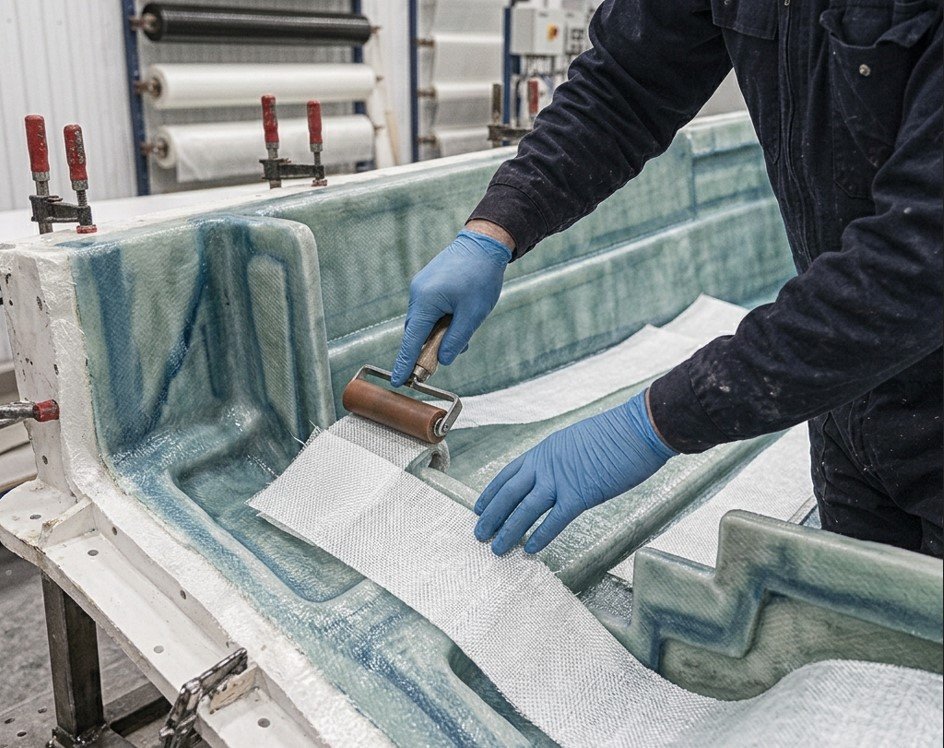
The inside of the mould is first coated with gelcoat — a layer of resin that becomes the smooth outer surface of the figure once released. Layers of glass mat go on top, each saturated with resin and pressed down with a roller.
This is the moment captured in the photograph and at the same time the most craft-driven part of the whole job. The roller presses the mat into the mould and distributes the resin evenly through the fibre structure. The result is a uniform laminate of the same thickness at every point — including corners and areas of complex geometry, where it sits tightest against the mould. This stage cannot be automated, and how even the finished surface turns out depends on the laminator's experience.
Vertical surfaces are worked with the addition of aerosil, a thixotropic agent that thickens the resin so it stays in place on a vertical face throughout curing. A simple measure, and it gives equal laminate thickness across the full height of the figure, from the base to the highest point.
How many layers, and what that gives
Our standard is 2 x 300 g glass mat, producing roughly 4 mm of finished laminate. That thickness follows directly from what the figure is meant to do:
- it carries its own weight unaided, holding its geometry at any height,
- it performs in wind even with a large side area,
- it takes loading, transport and repositioning in its stride,
- it withstands direct contact with visitors — with figures on playgrounds and benches in zoos we assume children will climb on them.
A mineral-and-resin mass is placed in the lower part of the figure. It lowers the centre of gravity, so the figure stands stably without anchoring or a foundation, and it stiffens the base at the same time. This simplifies installation: the piece is set down directly on paving, bark or grass.
Finishing and painting
Released from the mould, the figure goes through filling and sanding. This stage is invisible in the finished product and takes little less time than the lamination itself — it is what decides how smooth the surface is and why the joints between segments cannot be felt under the hand. Sculptural detail such as facial expression, teeth or fur texture is refined here, by hand.
We paint with acrylics and seal the whole piece with a two-component automotive clearcoat. It is the same material used on car bodies, and for the same reason: it holds its colour in full sun and takes pressure washing. We give five years of warranty on the paint system and three on workmanship, counted from the signing of the acceptance protocol.
How we do it
Every figure in our catalogue is made with the same technology: PWS laminate, 2 x 300 g mat, engineering resin, aerosil on vertical surfaces, mineral-and-resin mass in the base, acrylic paint and two-component clearcoat. That specification applies equally to a garden figure and to a fourteen-metre monument — what differs is scale and internal structure, not the standard of execution.
We also deliver bespoke projects, from the 3D model through to installation on site, and renovations of pieces made years ago. The latter give us the best insight into how laminate behaves after a decade on display — and that knowledge feeds back into every new commission.
If you are planning a figure for a park, a zoo, a shopping centre or a shop front, and you want to talk about how it will be made rather than about price alone — get in touch. Ready-made designs are in our shop.